

10 January 2026 | Virtual Event
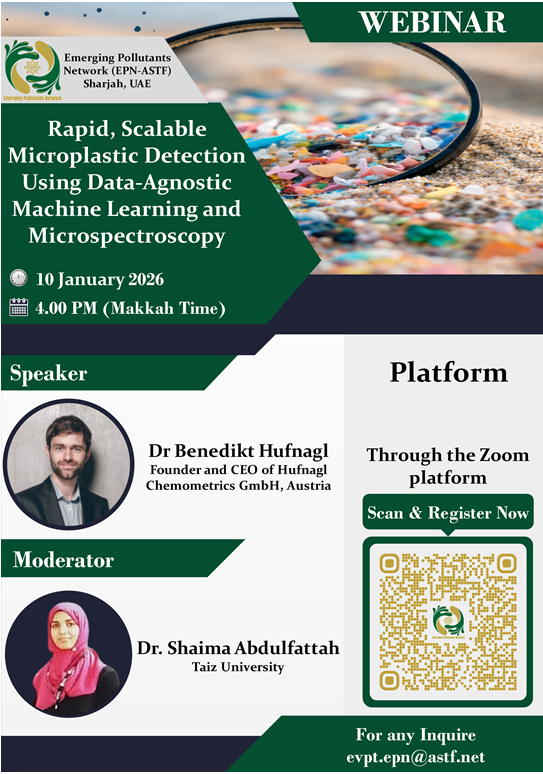
The Emerging Pollutants Network (EPN–ASTF) hosted a high-level scientific webinar on 10 January 2026 titled “Rapid, Scalable Microplastic Detection Using Data-Agnostic Machine Learning and Microspectroscopy”, highlighting next-generation analytical technologies designed to transform environmental monitoring of microplastics.
The webinar brought together environmental scientists, analytical chemists, and researchers from across the Arab region and internationally, addressing one of the most pressing challenges in microplastics research: the need for faster, more accurate, and scalable detection methods capable of supporting large monitoring programs.
Advanced detection technologies
The session was delivered by Benedikt Hufnagl, Founder and Chief Executive Officer of Hufnagl Chemometrics GmbH (Austria), a specialist in chemometric analysis and data-driven spectroscopic applications. Dr. Hufnagl presented cutting-edge approaches that combine microspectroscopy techniques (including FTIR and Raman spectroscopy) with data-agnostic machine learning models to automate and accelerate microplastic identification.
The presentation demonstrated how these models can analyze complex spectral datasets without reliance on predefined polymer libraries, significantly reducing operator bias and improving detection performance across a wide range of particle sizes and polymer types. According to the speaker, such approaches represent a major shift from traditional manual and semi-automated workflows toward fully scalable, high-throughput microplastics analysis.
Implications for environmental monitoring
Experts emphasized that data-agnostic machine learning has the potential to dramatically improve monitoring efficiency, enabling laboratories to process larger sample volumes in shorter timeframes while maintaining analytical robustness. This is particularly critical for resource-limited settings, where access to specialized expertise and extensive reference databases remains a challenge.
The webinar also highlighted how these technologies can support harmonized regional monitoring programs, improve cross-study comparability, and generate more reliable datasets for environmental risk assessment and policy development.
Capacity building and regional relevance
The session was moderated by Shaima Abdulfattah Gamal, from the Department of Microbiology, Faculty of Applied Sciences, Taiz University, who guided discussions on practical implementation of these technologies within Arab research institutions and environmental laboratories.
Participants engaged in an interactive discussion on integrating machine-learning-based detection tools into existing monitoring frameworks, training technical staff, and aligning analytical outputs with regulatory and policy needs.
Toward future-ready monitoring systems
Held virtually via the Zoom platform at 4:00 PM Makkah Time, the webinar formed part of EPN’s broader capacity-building program aimed at bridging advanced global innovations with regional environmental challenges. The event underscored the growing role of artificial intelligence and computational tools in environmental sciences and their potential to support evidence-based decision-making on plastic pollution.
EPN noted that the webinar represents an important step toward establishing future-ready microplastics monitoring systems in the Arab region, supporting sustainable environmental management and public health protection in line with international best practices.