

13 December 2025 | Virtual Event
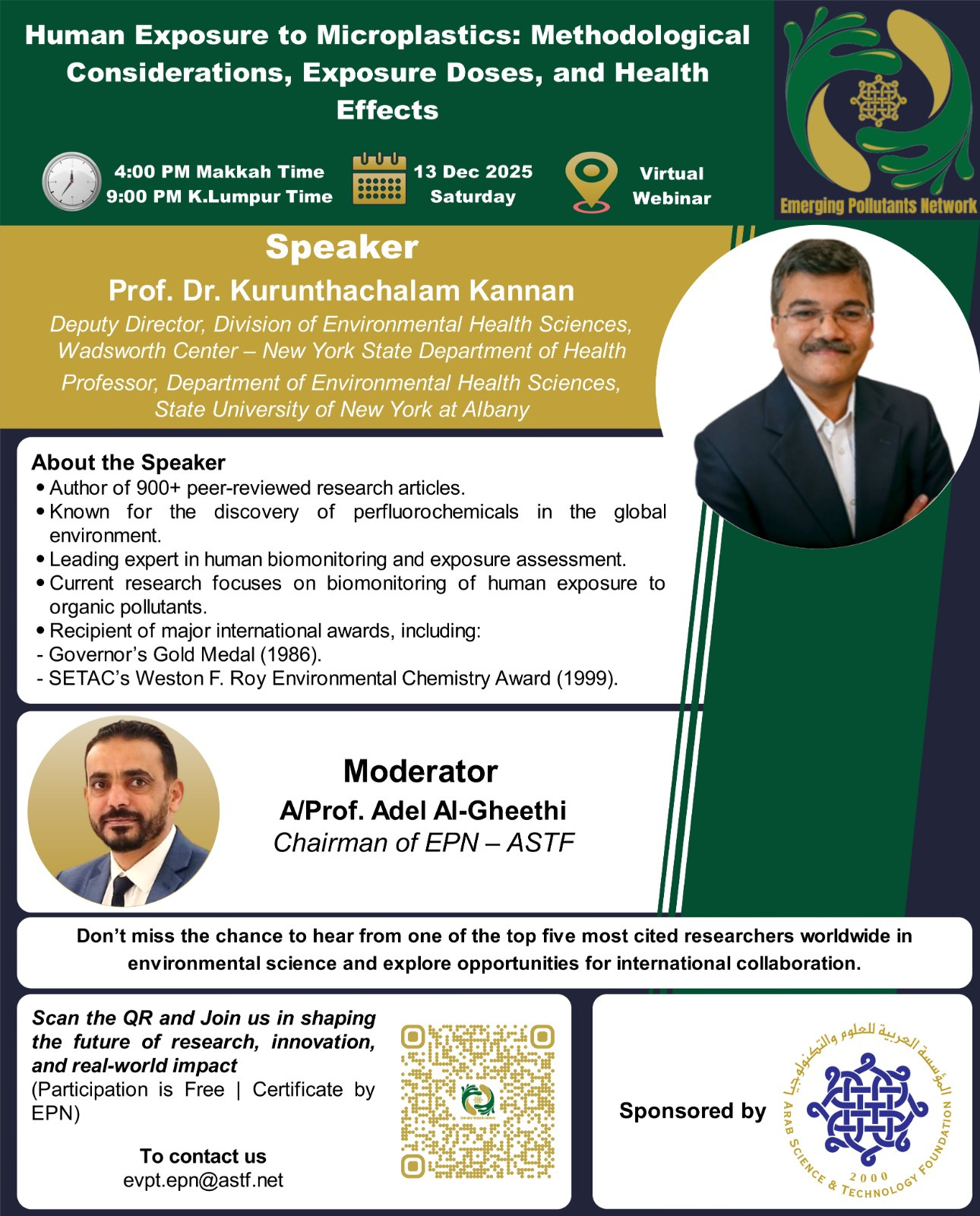
The Emerging Pollutants Network (EPN) hosted a high-level international webinar titled “Human Exposure to Microplastics: Methodological Considerations, Exposure Doses, and Health Effects” on Saturday, 13 December 2025, bringing together researchers, public health professionals, and environmental scientists from across the Arab region and the international scientific community.
The webinar was delivered by Kurunthachalam Kannan, Professor of Environmental Health Sciences at the State University of New York at Albany and Deputy Director of the Division of Environmental Health Sciences at the Wadsworth Center, New York State Department of Health. Widely recognized as one of the world’s most cited environmental scientists, Professor Kannan has authored more than 900 peer-reviewed scientific publications and is internationally known for his pioneering work in human biomonitoring and exposure assessment, including the discovery of perfluorochemicals in the global environment.
Scientific focus of the lecture
The lecture provided an in-depth examination of human exposure pathways to microplastics, with a structured analysis of ingestion, inhalation, and dermal contact as the dominant routes of exposure. Drawing on recent analytical and biomonitoring studies, Professor Kannan highlighted evidence of microplastics in food items, drinking water, indoor and outdoor air, and consumer products, underscoring the growing relevance of microplastics as an emerging public health concern.
A major component of the presentation addressed methodological challenges in exposure science, including contamination control, variability in sampling approaches, particle size detection limits, polymer identification, and the lack of standardized protocols—particularly for nanoplastics. The lecture emphasized that these limitations contribute to significant uncertainty in current exposure dose estimates and hinder cross-study comparability.
Health implications and research gaps
Professor Kannan reviewed the current understanding of potential health effects associated with microplastic exposure, referencing experimental and toxicological studies suggesting links to inflammatory responses, oxidative stress, immune system modulation, and cellular toxicity. However, he stressed that epidemiological evidence remains limited, with a notable absence of long-term population studies capable of establishing causal relationships between exposure and disease outcomes.
The lecture highlighted the urgent need for robust human biomonitoring programs, improved analytical sensitivity, and region-specific exposure assessments, particularly in developing and rapidly urbanizing regions.
Policy relevance and public health integration
A key theme of the webinar was the translation of exposure science into public health policy. Participants discussed strategies to integrate microplastics into environmental health surveillance systems, risk assessment frameworks, and regulatory agendas. The session emphasized interdisciplinary collaboration between environmental scientists, toxicologists, clinicians, and policymakers as essential for effective risk management.
The webinar was moderated by Adel Al-Gheethi, Chairman of the Emerging Pollutants Network, who highlighted the importance of strengthening Arab scientific capacity and aligning regional research efforts with global best practices.
Building regional capacity
Held virtually at 4:00 PM Makkah Time (9:00 PM Kuala Lumpur Time), the event attracted wide participation and formed part of EPN’s ongoing program to connect Arab researchers with leading international experts, promote knowledge transfer, and advance evidence-based decision-making on emerging environmental pollutants.
EPN noted that the webinar represents a strategic step toward fostering regional research initiatives on microplastics exposure, enhancing laboratory capabilities, and supporting the development of harmonized guidelines to protect environmental and public health in the Arab region.